The roaster is only part of the equation
When people ask us what it costs to start roasting, they usually mean the price of the roaster. That is the biggest single line item, but it is not the whole picture. A working roastery needs supporting equipment, the right space, proper power, and a plan for ongoing costs. Here is what the full picture actually looks like.
Choosing your roaster size
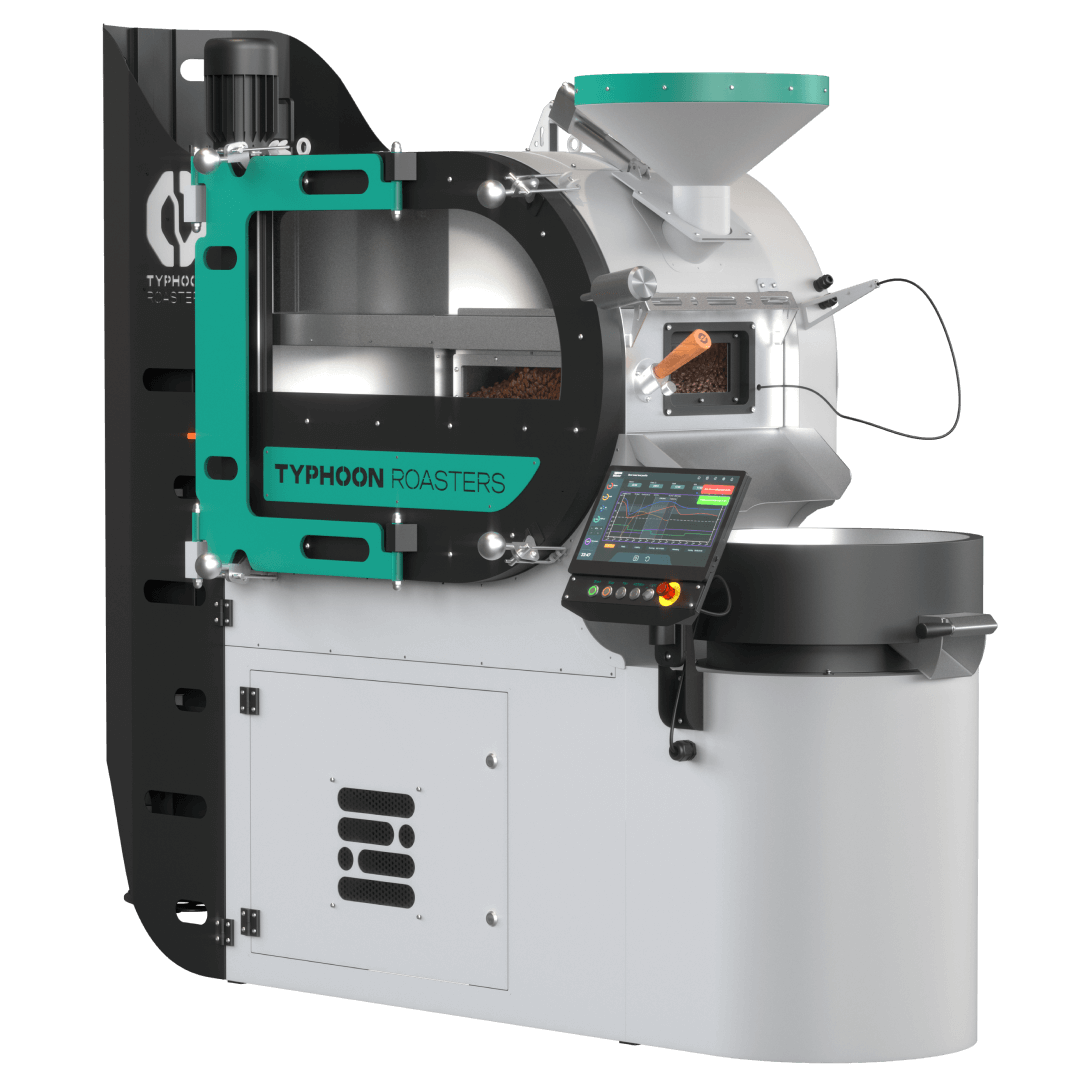
The Typhoon lineup gives you a clear path from small-batch to production-scale roasting. If you are a cafe owner who wants to roast in-house, the Typhoon 2.5 PRO handles up to 2.5 kg per batch and fits behind a counter or in a back room. It is a real production roaster, not a sample roaster dressed up for retail.
For dedicated roasting operations supplying wholesale accounts, the 5 PRO and 10 PRO are the workhorses. The 5 PRO handles up to 5 kg per batch and suits roasters doing 50-150 kg per day. The 10 PRO, at up to 10 kg per batch, is built for operations pushing 200+ kg daily. For high-volume production, the 30 kg model handles industrial throughput.
Supporting equipment you will need
The roaster does not work in isolation. Here is what else goes into a functional roasting setup:
| Equipment | Purpose | When you need it |
|---|---|---|
| Destoner | Removes stones and foreign objects from roasted coffee | Any production operation |
| Mixer | Blends different roasted origins evenly | If you sell blends |
| Vacuum loader | Moves green coffee into the roaster hopper | Larger roasters (10 PRO, 30 kg) |
| Air filtration / afterburner | Controls smoke and odor from roasting | Urban locations, shared buildings |
| Packaging equipment | Bags, sealer, valve applicator, scale | Any operation selling retail bags |
Space and power requirements
Every Typhoon model runs on three-phase 380-400V power. Most commercial and industrial spaces already have this or can get it installed. You will also need space around the roaster for airflow, cooling, green coffee storage, and packaging. The 2.5 PRO has a small footprint and works in tight spaces. The 10 PRO and 30 kg models need a dedicated room or warehouse bay.
Because the Typhoon is fully electric, you do not need a gas line, combustion ventilation, or flame safety systems. That simplifies permitting in most jurisdictions and opens up locations where gas equipment is not allowed.
Ongoing costs and where you make money
Your recurring costs break down into green coffee, energy, packaging, and labor. Green coffee is the biggest variable. Specialty-grade greens run $3-8 per pound depending on origin and quality. Energy costs on a Typhoon are remarkably low: 0.3 kWh per kg of roasted coffee, compared to 0.85 kWh/kg or more on a traditional drum roaster. Over thousands of kilos per month, that difference adds up fast.
On the revenue side, the margins in roasted coffee are strong. If you buy green at $5/lb and sell roasted at $14-16/lb retail (or $9-11/lb wholesale), you are looking at healthy margins even after accounting for roast loss, packaging, and labor. Most Typhoon owners we work with see a return on their equipment investment within 3-4 months when running at just 30% capacity.
Start small, then scale
One of the advantages of the Typhoon platform is that the roasting technology is consistent across all sizes. The same convection system, the same software, the same profile logic. A profile you develop on a 2.5 PRO transfers to a 5 PRO or 10 PRO with minimal adjustment. So you can start with a smaller machine, build your customer base, and upgrade when volume demands it, without re-learning your craft or re-developing all your profiles from scratch.
If you are planning a roasting operation and want to know exactly what the equipment package will cost for your situation, get in touch with us. We will put together a quote based on your production goals, space, and budget.