Your profile is your recipe
A roast profile is a time-temperature curve that defines everything about how a particular coffee is roasted. It tracks bean temperature, rate of rise, airflow settings, and energy input from charge to drop. Two different profiles applied to the same green coffee will produce two different cups. The profile is where your craft lives.
The four phases of a roast
Drying phase. The beans enter the roaster with 10-12% moisture content. During the first phase, that moisture is driven off. You will see the turning point (where bean temperature stops falling from the cold charge and begins to rise), and the beans will transition from green to pale yellow. In a Typhoon, this phase moves fast because convection transfers heat more efficiently than conduction.
Maillard/browning phase. The beans shift from yellow to tan to light brown. This is where sugars and amino acids begin reacting. Sweetness and complexity start developing here. The rate of rise should be steady and controlled.
First crack. Pressure builds inside the bean until the cell structure fractures with an audible pop. The bean expands, releases CO2, and transitions from endothermic (absorbing heat) to exothermic (generating its own heat). This is the gateway to the development phase.
Development. Everything after first crack is development time. This is where you determine the final flavor character of the roast. Too short and the coffee will taste sour and underdeveloped. Too long and you lose origin character and acidity. The development time ratio (DTR), the percentage of total roast time spent in development, is one of the most useful metrics for dialing in consistency.
Rate of rise matters more than end temperature
A lot of newer roasters fixate on the final bean temperature at drop. But the path you take to get there matters more than the destination. Rate of rise (RoR) tells you how fast the bean temperature is climbing at any given moment. A smooth, gradually declining RoR through the development phase is what you want. If the RoR stalls or flattens, the beans bake and the cup goes flat and dull. If it crashes too steeply, you get underdeveloped flavors even at a seemingly correct end temperature.
The variables you can control
In any roaster, you have a set of inputs that shape the profile:
Charge temperature sets the starting conditions. A hotter charge gives a more aggressive start; a cooler charge gives a gentler ramp.
Energy input over time is your primary control for the shape of the curve. On a Typhoon, this means adjusting heater power.
Airflow is where convection roasters really differ from drums. In a Typhoon, hot air IS the heat transfer mechanism. Adjusting airflow directly changes how much energy reaches the beans. This gives you a more direct and responsive control than managing gas valves and drum speed on a traditional roaster.
Batch size relative to roaster capacity affects heat absorption. A full batch responds differently than a half batch. Stay consistent with batch size when developing profiles.
How the Typhoon software helps
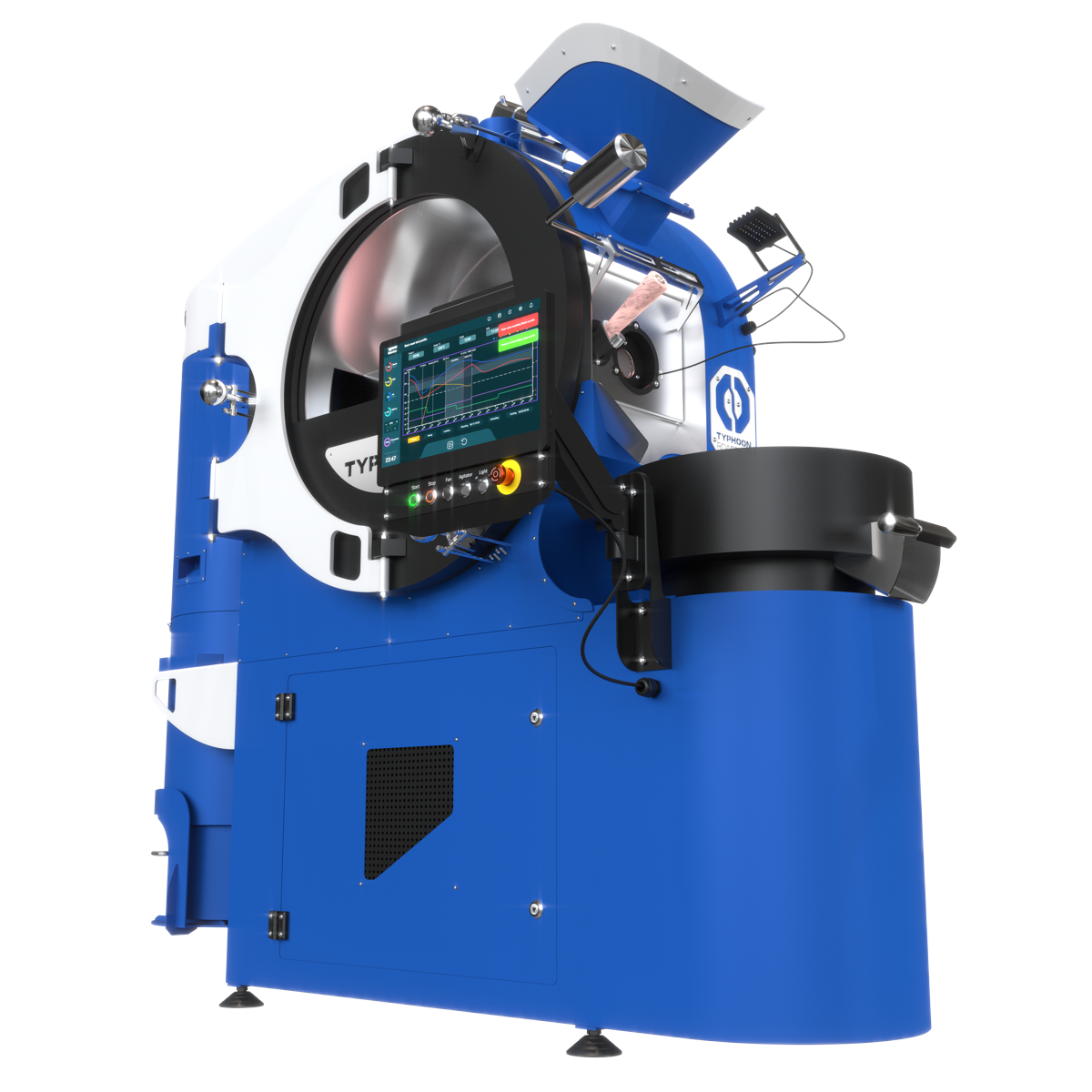
The Typhoon comes with a built-in profile management system on a 13-inch touchscreen. You can save profiles, recall them, and overlay real-time roast data against your target curve. The event-based roast control system lets you set automated adjustments at specific points in the roast (at turning point, at first crack, at a target temperature). It also integrates with Cropster and Artisan for external logging and analysis.
Profiling on convection vs drum
On a drum roaster, heat transfer is a mix of conduction (bean touching hot drum), convection (hot air moving through the drum), and radiation (infrared from the drum walls). You control it indirectly through gas/flame intensity and drum speed. There is always some lag between your adjustment and the bean response.
On a Typhoon, convection is the primary heat transfer mode. When you change airflow or heater power, the effect on the beans is more immediate. This makes the Typhoon more responsive to profile adjustments and gives you tighter control over RoR. Roasters who switch from drum to convection often say it feels like going from an analog control to a digital one.
Developing a new profile
Start with a known reference point. If you have a profile that works well for a similar origin or density, use it as your baseline. Roast the new coffee on that profile, cup it, and take notes. Then change one variable at a time. Maybe you extend development by 15 seconds. Cup it again. Compare. Repeat. This disciplined approach tells you exactly what each change does to the cup. If you change three things at once, you learn nothing.
Document everything. Every variable, every cupping note, every adjustment. Your profile library is one of the most valuable assets in your roasting business.
Want to see the Typhoon profile system in action? Schedule a demo with us and we will walk you through it with a live roast.