
Most roasteries do not plan their roasting schedules. They react. Monday morning arrives, orders have piled up over the weekend, and the roaster fires up with whatever feels most urgent. By Wednesday, something is behind schedule. By Friday, someone is roasting late into the evening to catch up.
This reactive approach works until it doesn’t. The moment your volume grows past a few hundred pounds a week, the lack of a real schedule starts costing you money in wasted time, inconsistent rest periods, and stress on your team. Here is how to build a schedule that actually holds up.
Map your real demand
Before you can build a schedule, you need to know what you are actually producing. Track your weekly output by product and blend for at least four weeks. You will start to see patterns: which SKUs move consistently, which spike on certain days, and which are low-volume but still need to stay in stock.
Break your products into tiers. Your top 3-5 blends probably account for 60-70% of total volume. Those are your anchor products, and they should get priority in any scheduling model. Single-origins and seasonal offerings fill in around them.
If you are supplying wholesale accounts (cafes, restaurants, grocery), their order cadence will drive much of your schedule. Retail and online orders tend to be more spread out and can often be batched.
Choose a scheduling model
There are three common approaches, and each suits a different type of operation.
A) Dedicated roasting days
You roast on specific days of the week (say, Monday and Thursday) and spend the other days on packing, shipping, and admin. This works well for smaller operations where the roaster and the packer are the same person. It simplifies the workflow and gives you clear boundaries. The downside is less flexibility when demand spikes or a large order comes in mid-week.
B) Rolling daily roasts
You roast a portion of your weekly volume every day, typically in the morning. This keeps inventory fresher and spreads the workload evenly. It works well for operations that ship daily or supply cafes that need frequent deliveries. The downside is that it requires the roaster to be available (and warmed up) every single day.
C) Hybrid
You designate 2-3 primary roasting days for your anchor products and keep 1-2 flexible slots for smaller batches, custom orders, or catching up. This is the most common model for mid-size roasteries and offers the best balance between predictability and flexibility.
Calculate your roaster hours
Once you know your weekly volume and scheduling model, you need to figure out how many hours of roasting that actually requires. This depends on your machine’s batch capacity and cycle time.
A general rule: load your roaster at 70-90% of its rated batch capacity for the best results. Running at 100% can cause uneven roasts, and running at 50% wastes energy and time.
For the cycle time, include the full sequence: loading, roasting, cooling, and unloading. On a traditional drum roaster, a full cycle for a 15 kg batch might look like this: 2 minutes to load, 14 minutes to roast, 5 minutes to cool, 1 minute to unload. That is about 22 minutes per batch, or roughly 2.7 batches per hour, giving you about 40 kg per hour at 15 kg per batch.
Here is a practical example. Say your weekly demand is 300 lbs (about 136 kg):
| Roaster type | Throughput | Hours needed |
|---|---|---|
| 15 kg drum roaster | ~40 kg/hr (~88 lbs/hr) | ~3.4 hours |
| Typhoon 5 PRO (convection) | ~30 kg/hr (~66 lbs/hr) at 5 kg batches | ~4.5 hours |
| Typhoon 10 PRO (convection) | ~60 kg/hr (~132 lbs/hr) at 10 kg batches | ~2.3 hours |
The Typhoon’s 6-7 minute cycle time (with no separate cooldown between batches since the cooling system works in parallel) lets you fit about 6 batches per hour. That changes the math significantly when you are trying to fit roasting into a compressed schedule.
Build in a buffer for rest and recovery
Your schedule cannot just account for roasting time. You also need to factor in the rest period before the coffee is ready to sell.
Espresso blends typically need 3-7 days of degassing after roasting. Filter roasts are usually ready in 2-4 days. This means that if a wholesale order ships on Friday, the espresso blend in that order needed to be roasted by Monday or Tuesday at the latest.
Work backwards from your ship dates and build in the rest period as a fixed constraint. Then add a buffer of 10-20% on top of your raw roasting hours to account for warm-up time, between-batch cleaning, QC checks, and the occasional batch that does not go as planned.
Communicate the schedule
A schedule only works if everyone knows about it. Post it visibly in your roasting space. Make sure your sales team knows the production calendar so they do not promise deliveries that conflict with your roasting and rest timelines. If you take custom orders, set clear lead times based on your actual capacity, not what you hope you can squeeze in.
For tracking, tools like Cropster’s RoastLog or dedicated inventory systems like Beanventory can help you match production to demand and catch shortfalls before they become emergencies.
How high-throughput systems change the equation
One of the biggest scheduling constraints is the roaster itself. If each batch takes 18-22 minutes on a drum roaster, your throughput ceiling is relatively fixed. To produce more, you either roast for more hours or buy a bigger machine.
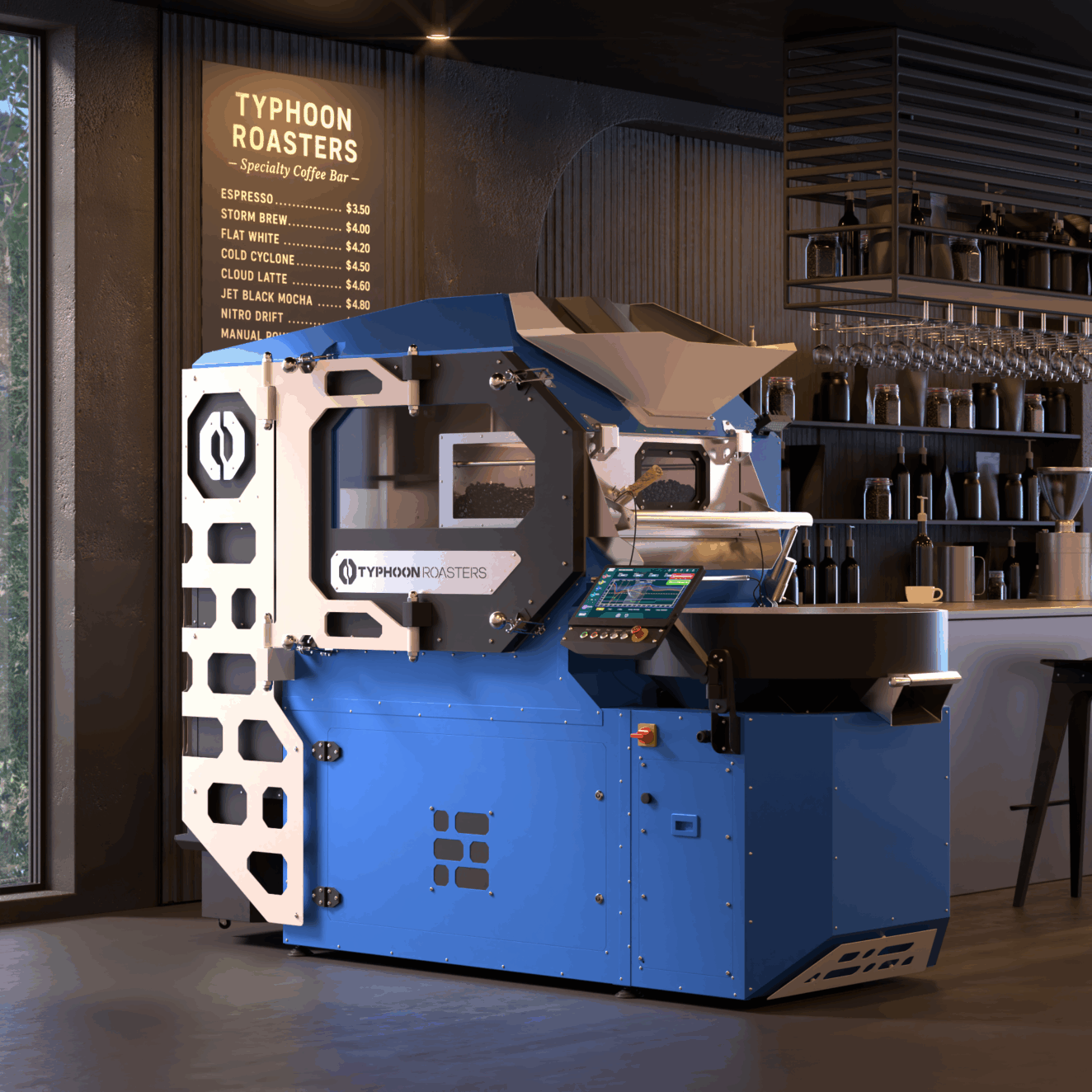
Convection systems like the Typhoon roasters we carry change this dynamic. With 6-7 minute roast cycles and an integrated cooling system that works simultaneously (so you are not waiting for one batch to cool before starting the next), you can process the same weekly volume in roughly half the time. That means fewer dedicated roasting hours, more flexibility to handle demand spikes, and less pressure on your team during peak periods.
For a roastery producing 500+ lbs per week, the difference between 10 hours of roasting and 5 hours of roasting is not just about efficiency. It frees up the rest of the day for profiling, QC, packing, or simply giving your team a break.
Putting it together
A good roasting schedule is not complicated. It starts with knowing your actual demand, choosing a model that fits your operation, calculating the time required, and building in buffers for rest periods and real-world hiccups. The goal is to stop reacting and start producing with intention.
If you are outgrowing your current schedule and want to explore how a higher-throughput roasting system could give you more room to breathe, talk to our team. We help roasteries across the US figure out the right equipment for their production demands.