
Most conversations about coffee roasting focus on temperature curves, development ratios, and the moment of first crack. The cooling phase rarely gets the same attention. That is a mistake. How you cool your beans after roasting has a direct effect on the final flavor in the cup, how long the coffee stays fresh, and how predictably your roast profiles translate from batch to batch.
The four phases of every roast
To understand why cooling matters so much, it helps to see it in context. Every roast moves through four distinct phases:
1. Drying. Moisture is driven out of the green beans. Temperatures rise gradually. The beans change from green to pale yellow.
2. Browning. The Maillard reaction and caramelization begin. Sugars and amino acids react to form hundreds of aromatic compounds. The beans turn light brown.
3. Roasting (development). First crack occurs as internal pressure builds. This is where the roaster makes their key decisions about how far to push the roast. Flavors are being created and transformed rapidly.
4. Cooling. The beans are dropped from the roasting chamber and cooled as rapidly as possible to halt all chemical reactions.
That fourth phase is not a passive winding-down. It is an active intervention. The beans come out of the roaster at 200-230°C (390-446°F), and they will continue to develop from their own residual heat. If you do not cool them fast enough, the roast keeps going. A perfectly timed City roast can drift into Full City territory in the cooling tray if the process is too slow. All the care you put into the first three phases can be undone in the last five minutes.
How fast is fast enough?
The industry standard is to bring beans from roasting temperature down to room temperature within 4-5 minutes. Some specialty roasters aim for even faster, targeting 3 minutes or less for light roasts where the margin for error is very tight.
The math is straightforward. You need to drop roughly 180°C (about 350°F) in under 5 minutes. That requires moving a large volume of cool air through the bean mass continuously. A slow, gentle cooldown is not the goal here. Speed is everything.
Air cooling: the standard approach
The most common and generally preferred method uses a cooling sieve (also called a cooling tray). This is a perforated metal tray with a powerful fan underneath that pulls ambient air down through the bean bed. A set of rotating arms stirs the beans to ensure even exposure to the airflow.
Several factors determine how effectively an air cooling system works:
Fan power and airflow volume. The fan needs to be sized appropriately for the batch size. A fan that is too small will not move enough air, and the beans in the center of the bed will cool much more slowly than those on the edges. As a rough benchmark, you want enough CFM (cubic feet per minute) to visibly agitate the beans on the tray.
Bean bed depth. A shallow, spread-out bed cools faster than a deep pile. If your batch size relative to your tray size creates a thick layer of beans, cooling will take longer and be less even. This is one reason why matching your batch size to your cooling system capacity matters.
Ambient temperature. Cooling performance degrades in hot environments. A roasting room at 95°F in the summer will cool beans more slowly than one at 65°F in the winter. Some roasters compensate by increasing fan speed or reducing batch sizes during warmer months.
Stirring mechanism. The rotating arms in the cooling tray are not just for show. They prevent hot spots by constantly turning the beans and exposing fresh surfaces to the airflow. A stuck or slow arm can create uneven cooling across the batch.
Water quenching: the commercial shortcut
Some large commercial operations use water quenching (also called misting) to accelerate cooling. A fine spray of water is applied to the beans either in the roasting drum just before discharge or in the cooling tray. The water evaporates on contact with the hot beans, pulling heat away rapidly through evaporative cooling.
When done precisely, water quenching can cool beans faster than air alone. But there are real risks.
Sogginess and quality. If too much water is applied, or if it is not applied evenly, the beans can absorb moisture. This changes the weight, the grind characteristics, and the flavor. Soggy spots in a batch can lead to mold growth in storage.
Weight manipulation concerns. Because water adds weight, there is a long-standing skepticism in the specialty coffee world about water quenching. Some buyers view it as a way to artificially inflate the weight of roasted coffee. Whether or not that is the intent, the perception exists, and it can affect your reputation with discerning buyers.
Equipment corrosion. Introducing water into a hot metal environment accelerates corrosion. Roasters that use water quenching need more frequent maintenance on their cooling systems and roasting chambers.
For specialty-grade coffee, air cooling is almost always the better choice. Water quenching has its place in high-volume commodity roasting, but the risks outweigh the benefits for most quality-focused operations.
What happens after cooling: degassing
Even after beans reach room temperature, they are not finished changing. During roasting, large amounts of CO2 are produced and trapped inside the cellular structure of the bean. This gas begins to escape immediately after cooling and continues for days afterward.
The degassing rate is fastest in the first 24 hours, then gradually slows. Most of the CO2 is released within the first 3-4 days, though some continues to escape for up to two weeks.
This matters for two practical reasons:
Brewing too early produces uneven extraction. Excess CO2 in the beans creates turbulence during brewing, causing water to channel through the grounds unevenly. The result is an inconsistent cup with a sharp, carbonic bite. For espresso, this is especially noticeable as erratic crema and sour flavors.
Grinding during active degassing is wasteful. If you grind beans while they are still releasing CO2 rapidly, much of that gas escapes immediately and takes volatile aromatic compounds with it. You lose flavor and aroma that would otherwise have ended up in the cup.
The practical takeaway: do not grind or brew your coffee within the first 24-48 hours after roasting. For espresso, most roasters recommend a 5-7 day rest. For filter coffee, 2-4 days is usually sufficient. Store the beans in bags with one-way degassing valves that let CO2 escape without admitting oxygen.
How cooling speed affects flavor
Beyond just stopping the roast at the right point, the speed of cooling has a measurable effect on the flavor profile.
Fast cooling locks in brighter acidity and preserves the more delicate aromatic compounds that develop during the late stages of roasting. These volatile compounds break down quickly at high temperatures, so the faster you get the beans below 100°C (212°F), the more of them survive. This is why fast cooling is especially important for light and medium roasts where those bright, complex notes are the whole point.
Slow cooling allows continued development, which can mute acidity and shift the flavor toward heavier, more roast-forward characteristics. In some cases, this is actually desirable. A few dark-roast producers intentionally slow the cooling slightly to develop more body. But for the vast majority of specialty applications, fast cooling produces better results.
Inconsistent cooling, where some beans cool fast and others lag, is the worst outcome. It produces a batch where individual beans are effectively at different roast levels. The grind will be uneven, extraction will be unpredictable, and the cup quality will vary from one brew to the next.
When are your beans “ready” after cooling?
Physically, beans are ready to handle and package as soon as they reach room temperature on the cooling tray. But “ready to package” and “ready to brew” are two different things.
For packaging, you can bag the beans as soon as they are cool to the touch, provided you are using bags with one-way degassing valves. The valves let the CO2 out without letting oxygen in, so you do not need to wait for degassing to complete before sealing.
For brewing, follow the rest times mentioned above. If you are selling directly to consumers, including a “roasted on” date and a brief note about ideal rest time on your packaging is a simple way to set expectations.
How Typhoon handles cooling automatically
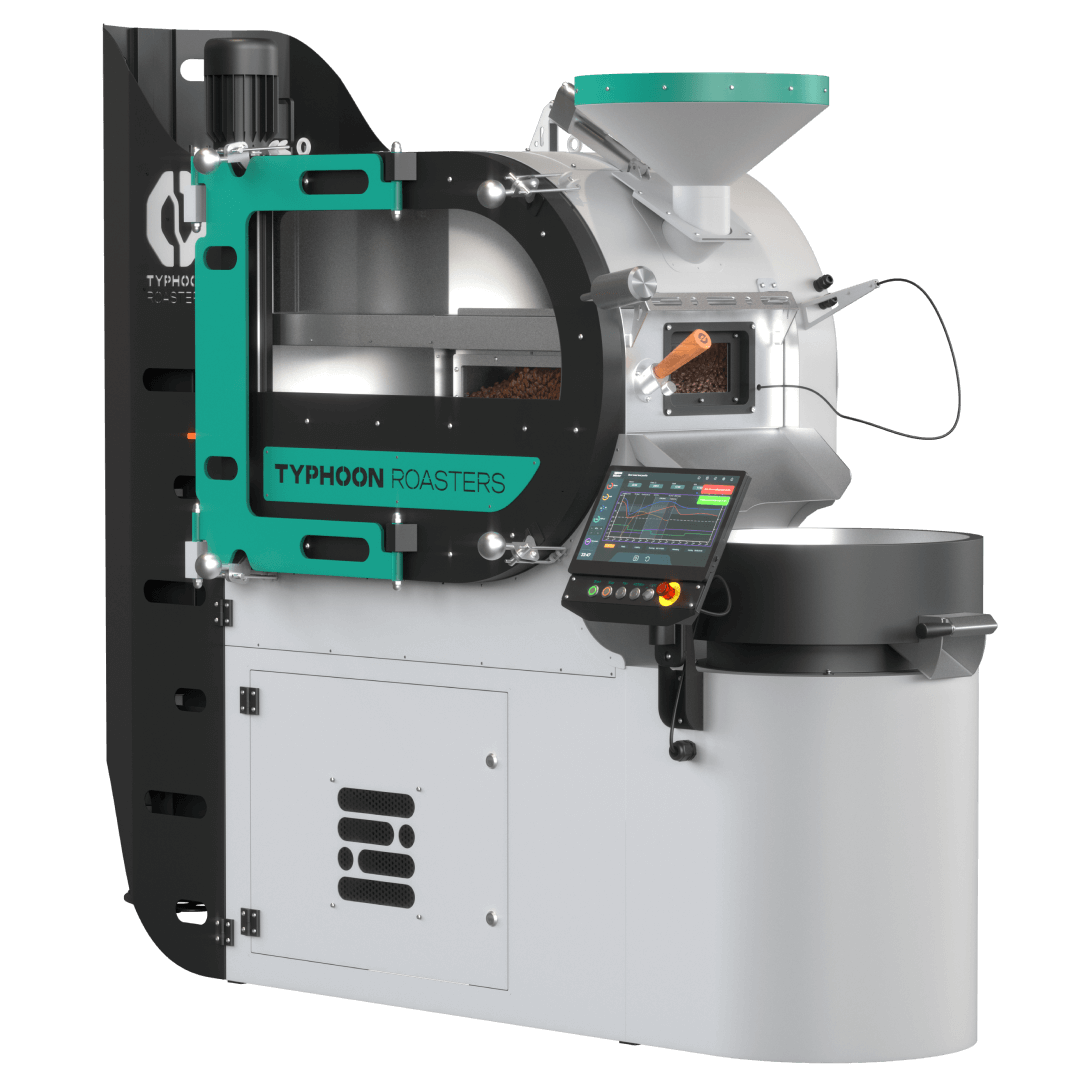
One of the design advantages of the Typhoon roasters we distribute is that the cooling system is fully integrated into the roasting cycle. When the roast completes, the beans are automatically discharged into a built-in cooling sieve that begins working immediately. There is no manual transfer step, no delay while you move beans from the roaster to a separate tray.
The integrated system also means the cooling begins at a consistent point in every batch. You are not introducing variability from the 10-15 seconds it takes to manually open a drum gate and dump beans onto a tray. For light roasts where that small window matters, this consistency adds up over hundreds of batches.
Because the cooling system operates in parallel with the roasting chamber, you can begin loading and heating the next batch while the previous one cools. This is how Typhoon achieves its 6-7 minute effective cycle time. The roaster is never sitting idle waiting for the cooling tray to finish.
Practical tips for better cooling
Whether you are using an integrated system or a standalone cooling tray, a few things will help you get better results:
Clean the tray perforations regularly. Chaff and residue can clog the holes in the cooling sieve over time, reducing airflow. A quick brush-down after each roasting session keeps performance consistent.
Check your fan performance seasonally. Fans degrade slowly, and belts stretch. A fan that cooled adequately when it was new may be underperforming two years later. Track your cooling times and investigate if they start to drift upward.
Account for ambient conditions. If your roasting room does not have climate control, your cooling performance will shift with the seasons. Logging your cooling times alongside ambient temperature helps you spot the correlation and adjust accordingly.
Do not stack fresh batches on top of warm beans. If you are running back-to-back batches on a standalone cooling tray, make sure the first batch is fully cooled and removed before the next one drops. Mixing beans at different temperatures produces uneven results.
The bottom line
Cooling is not the boring tail end of roasting. It is a phase that directly affects your cup quality, your production efficiency, and your ability to hit the same roast level batch after batch. Treat it with the same attention you give to your temperature profiles and development times.
If your cooling system is holding you back, or if you want to learn more about how integrated cooling works in a convection roasting setup, get in touch with us. We are happy to walk you through how the Typhoon system handles it.