Most retail coffee is a blend
Walk into any grocery store or cafe and pick up a bag of coffee. Odds are good it is a blend of two, three, or more single-origin beans. Blending is how roasters build a consistent flavor profile that customers recognize and come back for, month after month. It is also how roasters balance cost, availability, and seasonal variation in green coffee supply.
The challenge is consistency. When you are blending 10 or 20 kilograms at a time, hand mixing in a bin works well enough. But once you scale past that, the margin for error grows fast. One bag with too much of a bright Kenyan and not enough of a chocolatey Brazilian, and your regular customers notice. A commercial coffee mixer solves this problem entirely.
How the Typhoon coffee mixer works
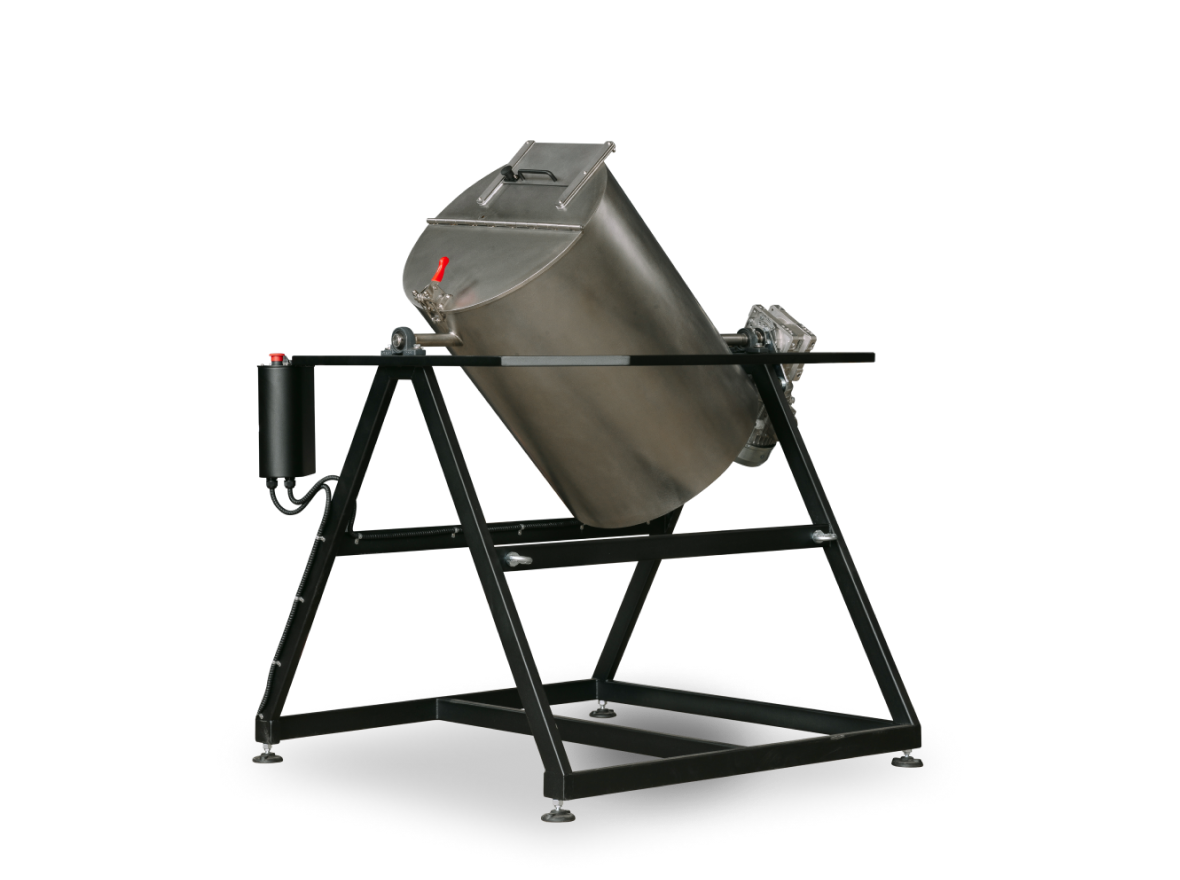
The Typhoon Coffee Mixer is a straightforward machine. You load your roasted single-origin coffees into the drum according to your blend recipe, press a button, and the drum rotates at an inclined angle to tumble the beans gently and thoroughly. Within about 3 minutes, you get 99% blend consistency across the entire batch.
There is no operator skill required beyond weighing the components correctly. The inclined drum design uses gravity to fold the beans over each other repeatedly, which is far more effective than any flat-bin paddle system. The full stainless steel construction means no flavor contamination between batches and easy cleaning when you switch blend recipes.
Three models for different production volumes
Typhoon builds the mixer in three sizes to match your roasting capacity:
| Model | Batch Capacity | Best Paired With |
|---|---|---|
| M-25 | 25 kg | 5-10 kg roasters |
| M-50 | 50 kg | 15-20 kg roasters |
| M-100 | 100 kg | 30 kg roasters |
The sizing logic is simple. Your mixer capacity should be at least 2-3x your roaster batch size so you can combine multiple roast batches into a single blending run.
When you actually need a mixer
If you are roasting under 20 kg per day and only run one or two blend recipes, you can get away with hand blending in bins. It is slow and labor-intensive, but the volume does not punish inconsistency as hard.
Once you are producing 50+ kg of blended coffee per day, or running more than three blend recipes, the math changes. The time your staff spends hand-mixing is time they could spend roasting, packing, or fulfilling orders. And the risk of an inconsistent batch going out to a wholesale account becomes a real business problem. At that volume, a mixer pays for itself quickly in labor savings and quality control.
Where it fits in your roasting workflow
The standard production flow with a Typhoon roaster and mixer looks like this:
1. Clean your green coffee through the destoner
2. Roast each single origin to its own profile
3. Cool and rest the roasted beans
4. Weigh each component according to your blend recipe
5. Load into the mixer and run a 3-minute cycle
6. Discharge directly into bags or a packing hopper
Post-roast blending (as opposed to pre-roast blending) is the industry standard for specialty coffee because each origin gets the roast profile it needs. The mixer is the final step that brings everything together before packaging.
Talk to a Specialist
Alpha Coffee Equipment is the exclusive US distributor for Typhoon roasters and accessories. If you are scaling up your blending operation or building out a new roastery, contact us for mixer pricing and lead times. We can help you size the right model for your production volume.