What is hiding in your green coffee
Green coffee travels a long way before it reaches your roastery. It is picked, processed, dried, milled, bagged, shipped across an ocean, and warehoused before you ever open that burlap sack. Along the way, foreign objects find their way in. Small stones, twigs, metal fragments, dried plant matter, even pieces of concrete from processing patios. Every experienced roaster has a story about finding something unexpected in a batch of green beans.
These contaminants are not just unpleasant. They are a real operational risk. A stone that makes it through roasting and into a grinder will chip or crack burrs, costing hundreds of dollars in replacement parts and downtime. Worse, a foreign object that makes it into a customer”s cup is a safety issue and a liability exposure that no roaster wants to deal with.
How a destoner works
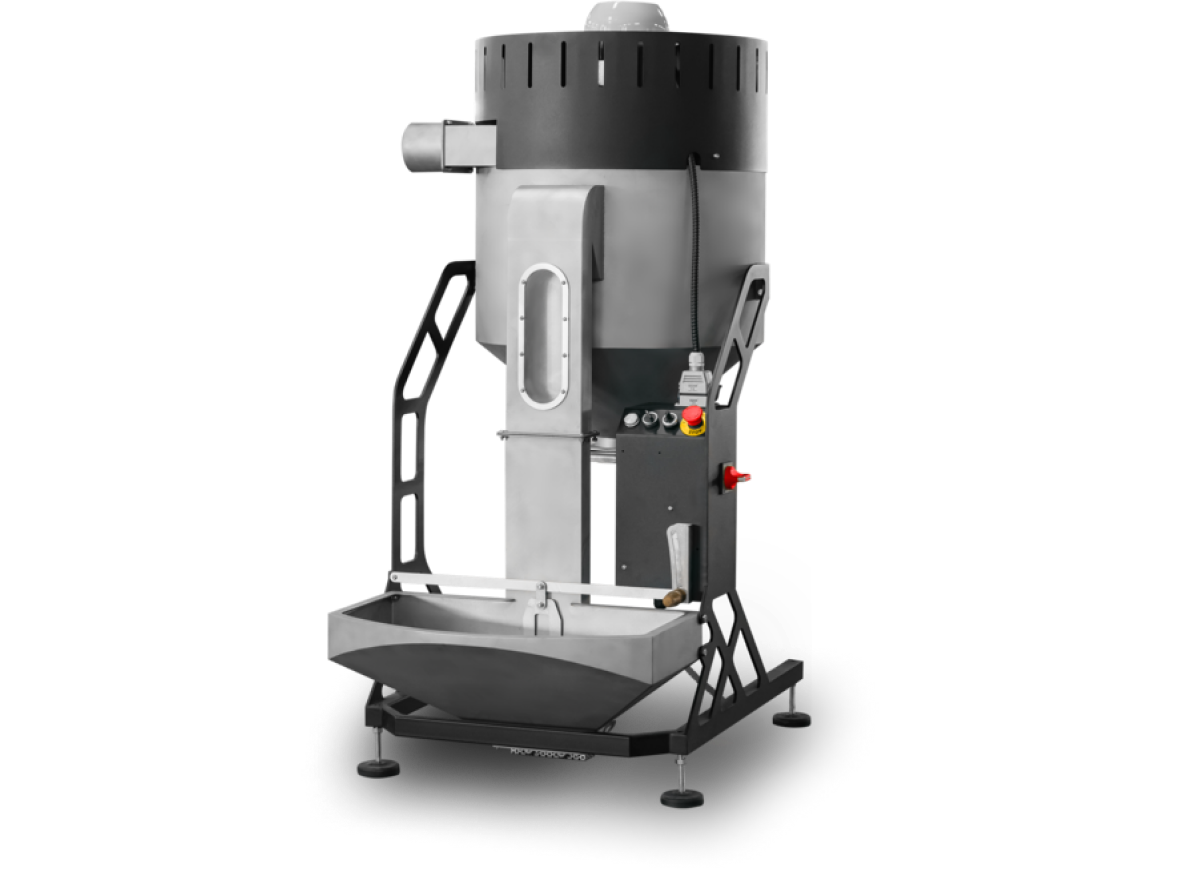
A coffee destoner uses the simple principle that stones and metal are heavier than coffee beans. The Typhoon destoner combines gravity separation with vacuum air technology to sort beans from debris. Green coffee is fed into the machine, and a controlled airstream lifts the lighter coffee beans while heavier foreign objects fall into a separate collection tray. The result is 99.9% cleaning efficiency in a single pass.
The process takes seconds per batch and requires no operator judgment. You pour green coffee in, clean coffee comes out, and the debris collects in a tray you empty periodically. It is the simplest machine in your roastery, and one of the most important.
Models matched to your roaster size
Typhoon makes three destoner models, each sized to feed a specific range of roasters:
| Model | For Roasters | Dimensions (cm) | Power | Weight |
|---|---|---|---|---|
| V-5 | 2.5 – 5 kg | 45 x 35 x 65 | 0.25 kW | 18 kg |
| V-20 | 10 – 20 kg | 55 x 45 x 85 | 0.55 kW | 32 kg |
| V-30 | 30 kg | 65 x 50 x 95 | 0.75 kW | 45 kg |
All three models run on standard single-phase power. They are compact enough to sit beside your roaster or on a shelf near your green coffee storage.
The cost of skipping this step
Some roasters, especially smaller operations, skip the destoning step and rely on visual inspection of their green coffee. This works until it does not. Consider what a single stone can cost you:
A chipped grinder burr set runs $200 to $800 depending on the grinder. Roaster drum damage from a large stone can mean weeks of downtime waiting for parts. And if a foreign object reaches a customer, the reputational and legal costs dwarf the price of any equipment repair.
A destoner is cheap insurance. It is one of the lowest-cost machines in a roastery setup, and it eliminates a category of risk entirely.
Where it fits in your workflow
The destoner sits at the very beginning of your production line. Before any green coffee goes into the roaster, it passes through the destoner first. The workflow is simple:
1. Receive green coffee from your importer
2. Weigh out your batch
3. Run it through the destoner
4. Load the cleaned green coffee into your roaster hopper
5. Roast as normal
Some roasters destone their entire green coffee inventory when it arrives, storing the cleaned beans ready for roasting. Others destone batch by batch. Either approach works. The point is that no green coffee should touch your roaster drum without being cleaned first.
Talk to a Specialist
Alpha Coffee Equipment carries the full range of Typhoon destoners. Whether you are setting up a new roastery or adding protection to an existing production line, contact us to find the right model for your operation.