A roaster is a capital investment, not just a piece of equipment
Buying a commercial roaster is not just a production decision. It is a capital investment. Whether you are pitching to outside investors, bringing partners on board, or justifying the expense to yourself, you need to frame it in business terms. Investors do not care about first crack timing or Agtron scores. They care about returns, risk, and timeline. Here is how to build a case that speaks their language.
Start with the market
Specialty coffee in the US is not slowing down. The market has grown steadily for over a decade, and consumer willingness to pay a premium for quality roasted coffee continues to climb. Your investors need to see that you are entering a growing market, not a saturated one. Include current market data and growth projections in your deck. Show that the demand is real and that your business is positioned to capture a piece of it.
If you are currently buying pre-roasted coffee for your cafe or wholesale operation, the cost comparison is straightforward. Calculate your current spend on roasted beans per month, compare it to the cost of buying green coffee and roasting in-house, and the margin improvement usually speaks for itself. For most operations, the savings on roasted coffee alone can cover the equipment payment.
Build your revenue projections
Investors want to see numbers. Put together revenue projections that account for your current volume, realistic growth targets, and the new margins you will achieve by roasting in-house. Be conservative. A projection that shows modest, believable growth is more convincing than a hockey stick chart that assumes everything goes perfectly.
Break down the math clearly. What does green coffee cost per pound? What is your roast loss percentage? What will you sell the finished product for? What is your monthly capacity at different utilization rates? Showing that you have done the work to understand your unit economics builds confidence that you know what you are doing.
Technology choice matters for the pitch
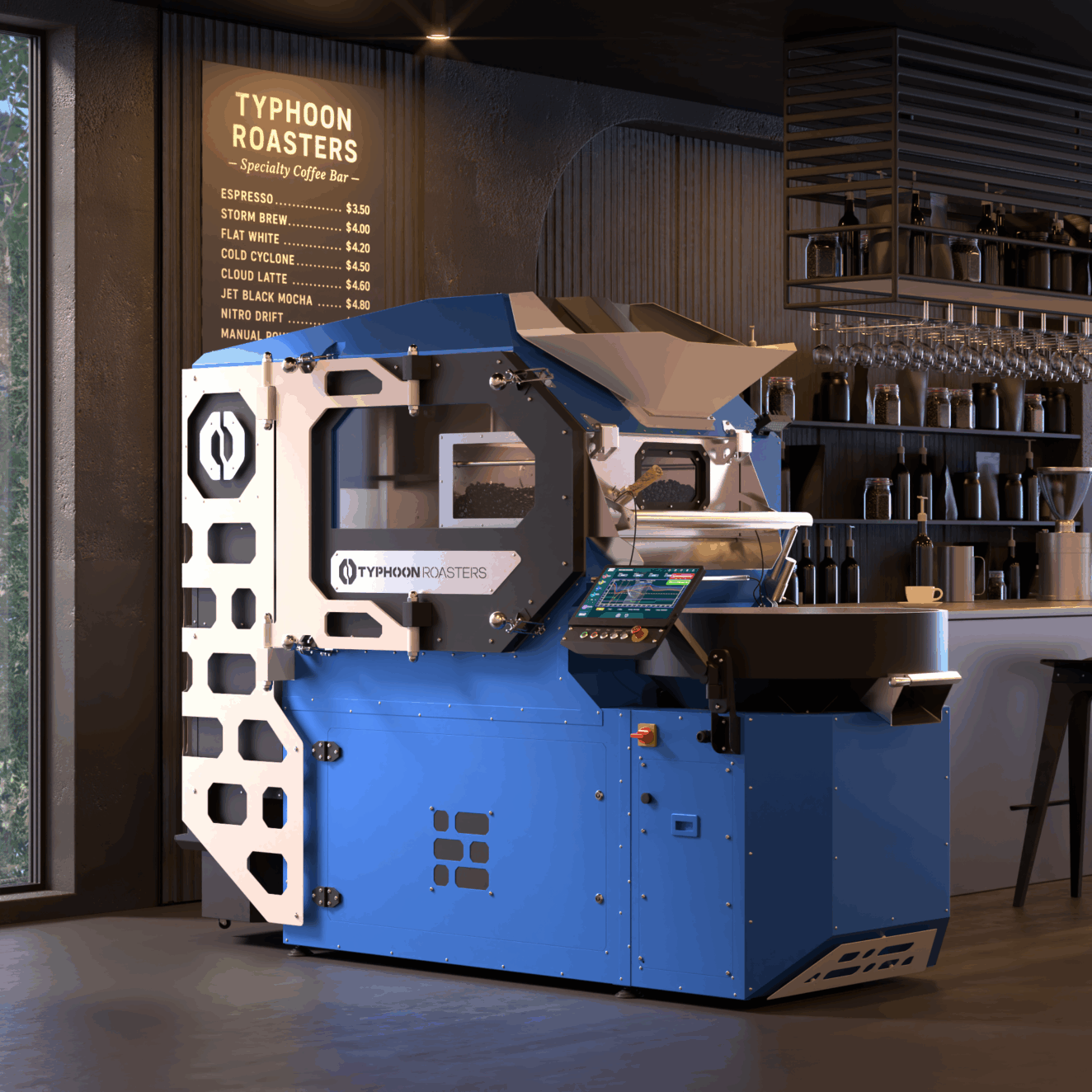
This is where your equipment decision becomes part of the business case. Choosing a Typhoon electric convection roaster removes several common investor objections before they come up.
No gas line required. Many commercial spaces do not have natural gas, and installing a gas line adds significant cost and permitting delays. An electric roaster plugs into standard industrial power. That means more location options and a faster path to production.
Lower energy costs. Typhoon roasters consume 0.3 kW per kilogram of coffee, compared to 0.85 kW/kg for a typical drum roaster. Over a year of production, that difference adds up to thousands of dollars in energy savings.
Faster payback. At just 30% capacity utilization, a Typhoon pays for itself in roughly 3 to 4 months. That is a number investors can get behind. Most drum roasters take 8 or more months at 50% utilization to reach the same point.
Reduced fire risk. No open flame and no gas means lower insurance premiums and fewer safety concerns. For investors evaluating risk, this is a tangible advantage.
Consistent quality from day one. Convection technology produces repeatable results without the steep learning curve of drum roasting. That means less waste during ramp-up and faster time to market with a product you can stand behind.
Show the ROI math
Every investor deck needs an ROI page. Lay out the total equipment cost, your projected monthly savings from in-house roasting, your expected revenue from roasted coffee sales, and the timeline to payback. Be specific. If your current roasted coffee cost is $8 per pound and you can roast green coffee for $4.50 per pound (including green cost, energy, labor, and packaging), that is $3.50 per pound in margin improvement. Multiply that by your monthly volume and the payback timeline becomes very clear.
Include the energy math as a separate line item. At 0.3 kW/kg, a Typhoon roaster running 100 kg per day costs roughly $2 to $3 in electricity, depending on your local rates. Compare that to gas costs for a drum roaster and the operational savings reinforce the capital investment story.
Present a realistic timeline
Investors want to know when things happen. Put together a timeline that covers equipment ordering, delivery, installation, training, initial production, and ramp-up to target capacity. Be honest about lead times and the learning period. A realistic timeline builds trust. An overly optimistic one creates problems later.
Address risk head on
Every investment has risks, and pretending otherwise makes you look unprepared. Name the risks and explain how you are mitigating them. Equipment failure? Typhoon roasters are built for commercial duty with straightforward maintenance. Market risk? You are entering a growing segment with proven demand. Execution risk? Start with conservative utilization targets and scale up as you build your customer base.
The strongest pitch is one that shows you have thought about what could go wrong and have a plan for each scenario.
Get a custom projection for your deck
Every roasting operation is different, and generic numbers only go so far. Contact Alpha Coffee Equipment and we will put together a custom ROI projection based on your specific volume, market, and growth targets. It is the kind of detail that turns a good investor pitch into a funded one.