If you have been researching commercial coffee roasters, you have probably come across two very different approaches to applying heat: drum roasting and convection (air) roasting. While drum roasters have dominated the industry for over a century, a growing number of specialty roasters are making the switch to 100% convection technology. Here is why.
How drum roasters work
In a traditional drum roaster, green coffee beans tumble inside a heated metal cylinder. Heat transfer happens primarily through conduction (direct contact between the bean and the hot drum surface) with some convective heat from hot air passing through the drum. This creates an inherent problem: beans touching the drum surface receive more heat than beans in the center of the tumbling mass.
The result is uneven development. Skilled roasters can mitigate this through careful charge temperatures, drum speed adjustments, and gas modulation, but the physics of conduction-based roasting mean that some degree of surface scorching and tipping is almost inevitable, especially at higher throughput speeds.
How convection roasters work
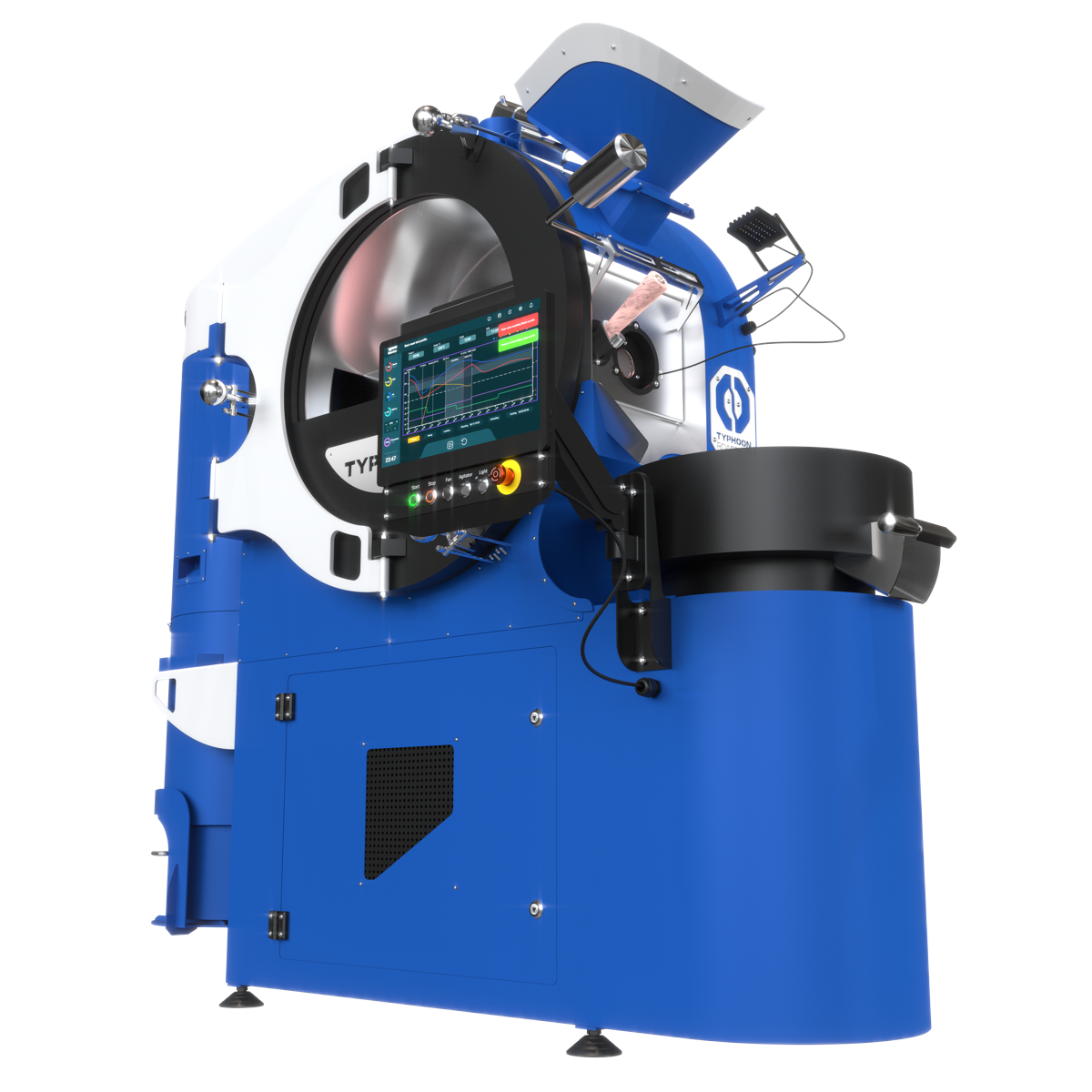
A 100% convection roaster like the Typhoon suspends beans in a precisely controlled stream of heated air. Every bean is surrounded by hot air at the same temperature, eliminating the contact-based hot spots that plague drum roasters. The beans are roasted from the outside in, uniformly, with zero scorching.
Because the heat transfer is more efficient (air reaches the entire surface area of every bean simultaneously), roast cycles drop from 12-15 minutes to just 5-7 minutes. There is no cooldown period between batches either, since the roasting chamber does not retain residual heat the way a metal drum does.
The numbers tell the story
Here is how the two technologies compare on the metrics that matter most to roasting businesses:
| Metric | Drum Roaster | Typhoon Convection |
|---|---|---|
| Roast cycle | 12-15 min | 5-7 min |
| Batches per hour | 3-4 | Up to 6 |
| Energy per kg | 0.85-1.2 kWh | 0.3 kWh |
| Payback period | 12-24 months | 3-4 months |
| Roast defects | Scorching, tipping common | Defect-free |
Energy savings add up fast
At 0.3 kWh per kg versus 0.85+ for drum roasters, a Typhoon uses roughly 65% less energy. For a roastery processing 500 kg per week, that difference translates to significant savings on your electricity bill, month after month. Combined with faster throughput (meaning fewer labor hours per kg), the total cost of ownership is much lower.
This is why most Typhoon owners see a full return on their investment within 3-4 months at just 30% capacity utilization.
Better for quality, better for business
The quality advantages of convection roasting are not just theoretical. Because every bean receives identical heat exposure, you get strong batch-to-batch consistency. Your light roasts will be uniformly developed without grassy or underdeveloped notes. Your dark roasts will be rich and full without the bitterness that comes from surface scorching.
For specialty roasters who sell by origin and profile, this consistency is essential. Your customers expect the same cup experience every time they buy your beans.
Making the switch
If you are considering upgrading your roasting operation, we would love to show you what convection roasting can do. Alpha Coffee Equipment maintains a Typhoon 10 PRO at our partner facility, Heartland Coffee Roasters in Lincoln, Nebraska. You can schedule a live demo, roast your own beans, and experience the difference firsthand.
Contact us for a free quote or to schedule your demo.