
The sound every roaster listens for
If you have spent any time around a roaster, you know the sound. A few minutes into the roast, the beans start popping, similar to popcorn but sharper. That is first crack, and it is the single most important marker in any roast. Everything before it is preparation. Everything after it is development. Understanding what is physically happening during first crack, and what it means for your coffee, is fundamental to roasting well.
What is happening inside the bean
As the bean heats up, the remaining moisture inside converts to steam. At the same time, chemical reactions are producing CO2. Both of these gases build pressure inside the bean’s cellular structure. When that pressure exceeds what the cell walls can contain, the structure fractures. That fracture is the crack you hear.
The physical changes are visible too. The bean expands in volume (sometimes by 50% or more), loses mass as moisture and CO2 escape, becomes less dense, and the silverskin (chaff) separates. The color shifts from brown to a more uniform medium brown. If you weigh your beans before and after roasting, you will typically see 12-20% weight loss depending on roast level, and much of that loss accelerates at first crack.
When to expect it
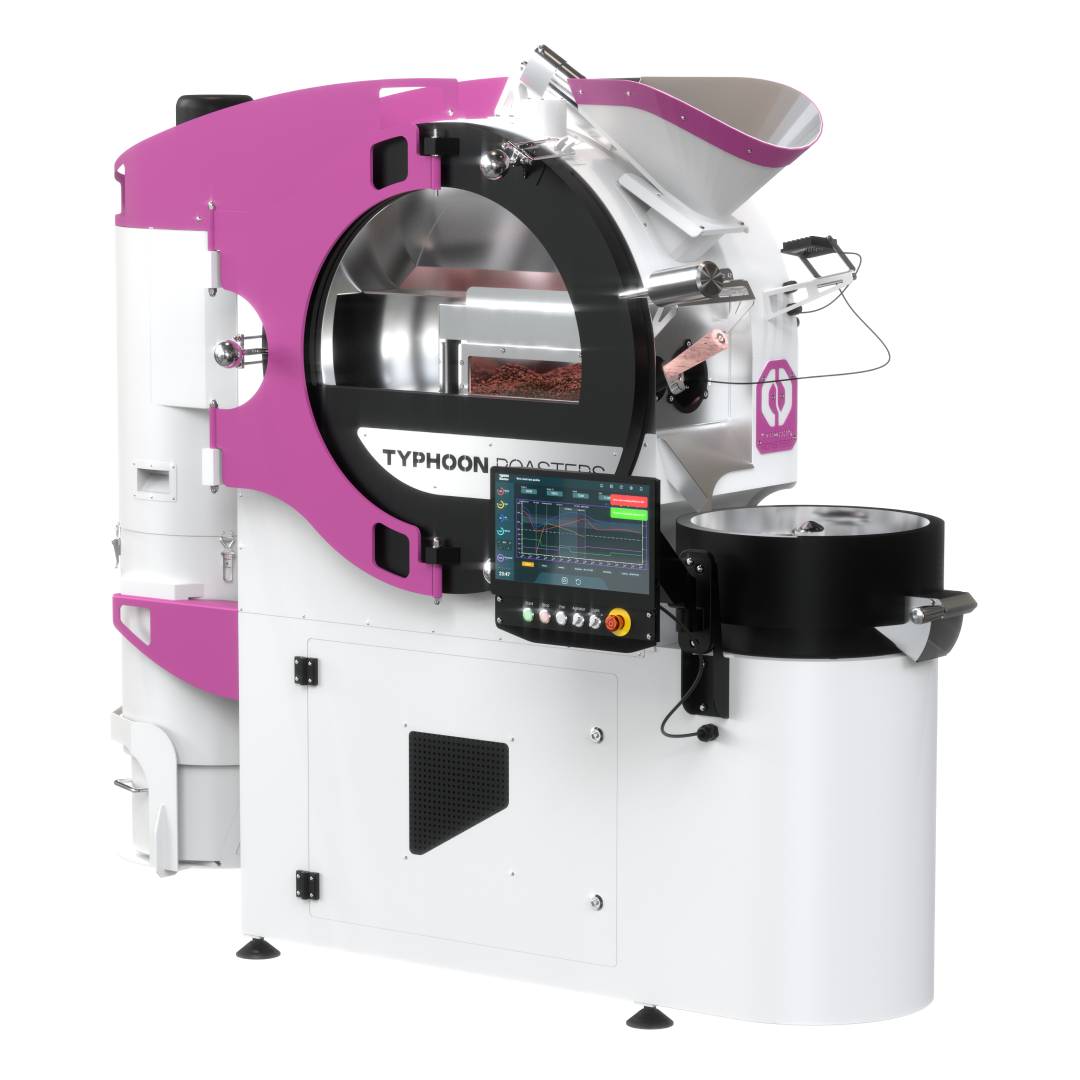
On a traditional drum roaster, first crack typically occurs 7-10 minutes into the roast, depending on batch size, charge temperature, and heat application. On a Typhoon convection roaster, expect it closer to 4-5 minutes. Convection transfers heat more efficiently and evenly than a drum, so the beans reach crack temperature faster. This is not rushing the roast; the beans are still going through the same chemical progression. They just get there sooner because the heat transfer is more direct.
Why first crack changes everything
First crack marks a transition in the thermodynamics of the roast. Before crack, the beans are endothermic: they are absorbing heat energy from the roaster. After crack, they become exothermic: the chemical reactions inside the bean are now generating their own heat. This means the beans will continue to develop even if you reduce energy input. If you keep pushing the same amount of heat after crack as you did before, the roast will accelerate and you can easily overshoot your target.
This is why most roasters reduce heat input at or just before first crack. You want a controlled coast into your target development level, not a runaway reaction.
Development time ratio
The time between first crack and drop (when you end the roast) is called development time. Expressed as a percentage of the total roast time, it gives you the development time ratio (DTR). This number is one of the most useful tools for profiling consistency. A DTR of 20-25% is a common range for medium roasts. Lighter roasts will be lower, darker roasts higher. The exact number depends on the coffee and your target, but tracking DTR lets you compare roasts objectively rather than relying on color alone.
Roast levels relative to first crack
| Roast level | When to drop | Cup character |
|---|---|---|
| Light | During or just after first crack ends | Bright acidity, origin character, floral/fruity notes |
| Medium | Well after first crack, before second crack | Balanced acidity and body, sweetness, chocolate/caramel notes |
| Dark | Into or through second crack | Low acidity, heavy body, smoky/bittersweet, less origin character |
Common mistakes around first crack
Missing it entirely. In a noisy environment or with a loud exhaust fan, you can miss first crack if you are not paying attention. On a Typhoon, the software tracks bean temperature and RoR in real time, so you can see the thermal signature of crack even if you cannot hear it clearly.
Inconsistent crack timing between batches. If first crack is happening at different times from batch to batch on the same profile, something is off. Check your charge temperature consistency, your green coffee moisture levels, and your batch weight. On a Typhoon, the profile replay feature makes it easy to overlay batches and spot where they diverge.
Confusing first and second crack. Second crack is quieter, more like rice crispies than popcorn, and it happens at a higher temperature. If you are hearing a second round of cracking and you were aiming for a medium roast, you have gone too far. Learn the difference by deliberately roasting a small batch dark enough to hit second crack so you know what it sounds like.
The Typhoon’s software tracks crack timing automatically and logs it as part of your profile data. Schedule a demo to see how it works in a live roast.